-
Feedback
- It was a wonderful experience ! The Great Wall is awesome... and judie was a masterful guide, wonderful !! John was an excellent driver, very crusteruo. Thank you for setting up such a great tour. Susie Was a Great Guide. Give us EveryThing We Wanted to Know. All Arrangement Went Smooth. Mr.Judie Was Good Driver. He Help Everyone In & Out of Van, Good Restaurant & Hotel service. Anton Christopher Grindl
- see more feedback
Discover BeijingParent CategorySite
Circular Mound Altar
- Being the sacrificial altar for ceremonies held on winter solstice in Temple of Heaven Beijing, Circular Mound Altar was first built in 1530 and extended in 1740.
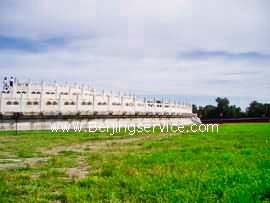
Circular Mound Altar, also called Huanqiutan in Chinese, is the sacrificial altar for ceremonies held on winter solstice. It was first built in 1530 and extended in 1740 by the Qing rulers. The altar is encircled by two walls, the inner wall taking a round shape to resemble heaven while the outer one squared to symbolize earth.
The three-tiered marble altar rises from the ground as high as five meters. The topmost layer of it is 30 meters in diameter, the middle one 50 meters, and the bottom layer 70 meters. Paved with nine rings of fan-shaped marble stone, each layer itself is a terrace with a flight of nine steps in four directions. At the center of the upper terrace there lays a round stone called Tianxingshi (Heaven's Heart Stone), which is surrounded by nine concentric circles from the first ring to the ninth, from nine pieces of stone sequentially to 81 pieces.
Link
Please link to us if you like the page.- Circular Mound Altar
- Being the sacrificial altar for ceremonies held on winter solstice in Temple of Heaven Beijing, Circular Mound Altar was first built in 1530 and extended in 1740.
- https://www.beijingservice.com/attractions/circularmoundalter.htm
The second terrace shows another nine concentric circles from the tenth ring to the 18th; and the third terrace consists of rings from the 19th to the 27th to form the third group of concentric circles. In all, marble slabs used on these three pavements add up to the total amount of 9 by 378, which equals 3402 pieces of stone slabs.
According to traditional Chinese cosmology, the figure of nine has been considered the supreme odd number. Even the carved balustrade surrounding the terrace is upheld altogether by 360 balusters, which embodies likewise the multiple of the figure of nine. What is more, the number 360 is also equal to degrees of circumference of the sky postulated by the ancients. The whole design of the altar makes one feel much closer to heaven.