-
Feedback
- It was a wonderful experience ! The Great Wall is awesome... and judie was a masterful guide, wonderful !! John was an excellent driver, very crusteruo. Thank you for setting up such a great tour. Susie Was a Great Guide. Give us EveryThing We Wanted to Know. All Arrangement Went Smooth. Mr.Judie Was Good Driver. He Help Everyone In & Out of Van, Good Restaurant & Hotel service. Anton Christopher Grindl
- see more feedback
Discover BeijingParent CategorySite
Forbidden City
- Forbidden City, also called Palace Museum or Gugong in Chinese, is located in the center of Beijing, to the north of Tian'anmen Square. It was the imperial palace during the Ming and Qing dynasties. Forbidden City is the largest and best-preserved palace complex in China and the treasure house of Chinese cultural and historical relics. The palace consists of 90 palaces and courtyards, 980 buildings and 8,704 rooms. It was listed as the World Cultural Relics in 1987.
Profile
- ID : 2
- City : beijing
- English name : Forbidden City
- Chinese name : 故宫
- Type : Museum,Imperial palace,Ancient mansion,
- Level : easy
- Kids : possible
- Elders: suggested
- Best season : Spring and Autumn
- Visiting length : 3 Hours
- Distance to city center : 1 km
Introduction
-
Forbidden City, also called Palace Museum or Gugong in Chinese, is located at the center of Beijing. Located to the north of Tiananmen Square, It was the imperial palace during the Ming and Qing dynasties.
Being the world's largest palace complex, Forbidden City covers an area of 74 hectares. Rectangular in shape, Forbidden City start from Tian'anmen Gate in the south, and put the north end at the Gate of Devine Prowess (Shenwumen) to the north. Travelers may find Jingshan Park when walk out Forbidden City from north gate.
Forbidden City covers two sections based on their different function: Office and living area.
The outer court mainly covers three halls, Hall of Supreme Harmony, Hall of complete Harmony and Hall of Preserving Harmony, where the emperor exercised his supreme power over the nation.
The northern section, or the inner court mainly covers the Palace of Heavenly Purity (Qianqinggong), the Palace of Earthly Tranquility , as well as the Palace of Union & Peace (Jiaotaigong). The emperor enjoy daily life with his royal family in inner court.
Photo
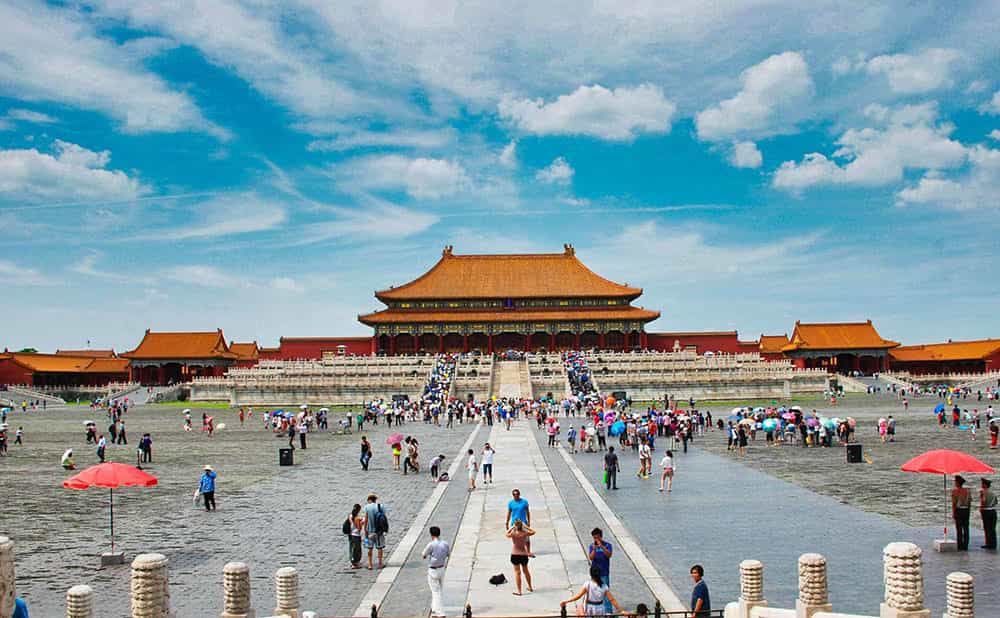
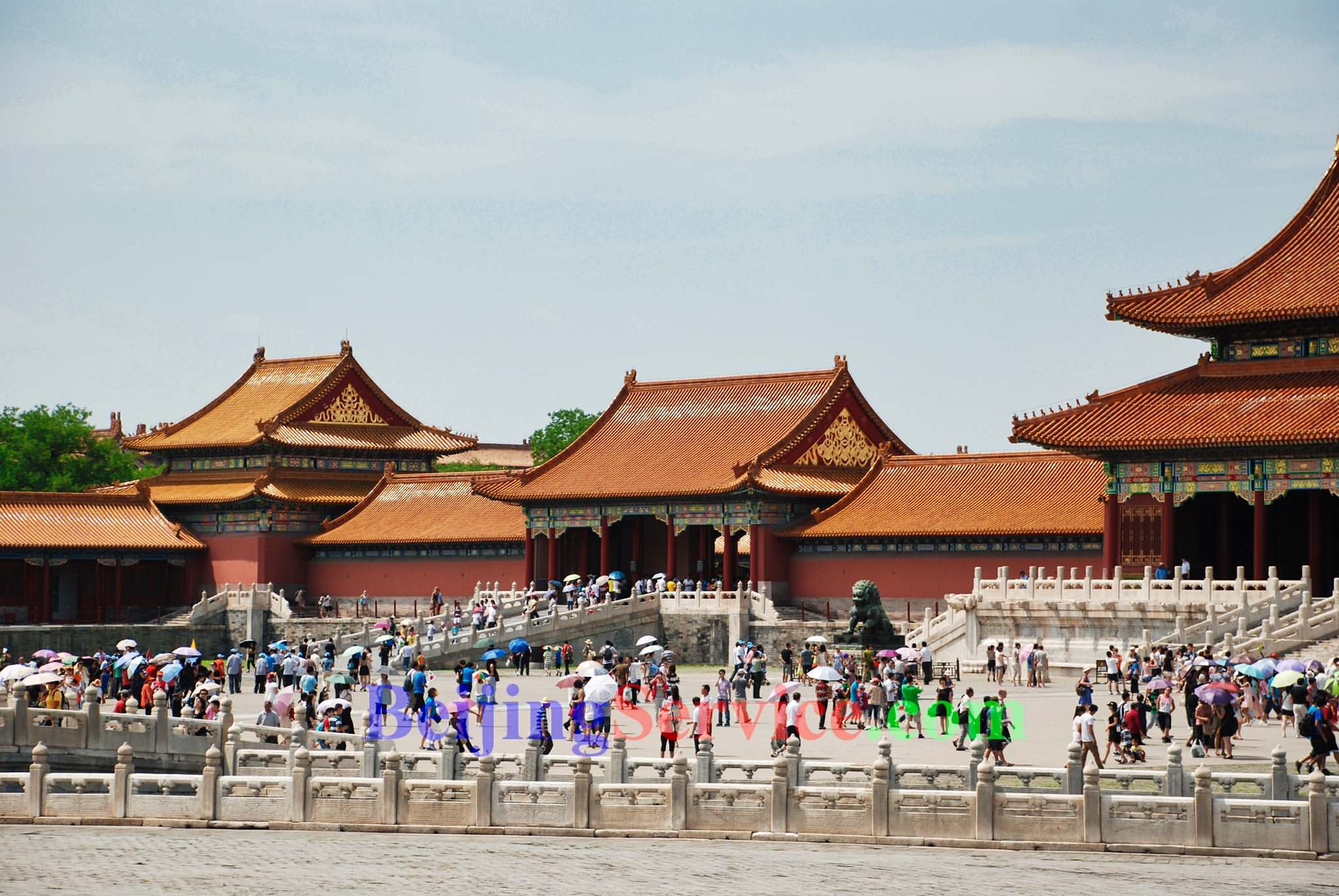
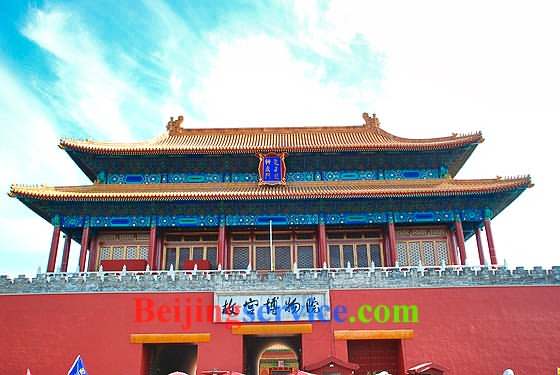
- This photo show you the main building ( The Hall of Supreme Harmony) of Forbidden City during daytime of Beijing.
Highlights
-
Meridian Gate, Hall of Supreme Harmony, Hall of complete Harmony, Hall of Preserving Harmony, Palace of Heavenly Purity, Hall of Metal Cultivation
Helper to visit Forbidden City
- Address in English : No.4 Jingshan Qianjie, Dongcheng District, Beijing, China
- Address in Chinese : 北京市东城区景山前街4号
- Tel : +8610-85007938
- Post code : 100009
- Ticket time : 8:30-16:00 (April 1st - October 31st), 8:30-15:30 (November 1st - March 31st )
- Open time : 31st 8:30-17:00 ( April 1st - October ), 8:30-16:30 (November 1st - March 31st)
- Closing time : Monday
- Location : Forbidden City is around 1 km to downtown beijing
- The Palace Museum has four gates:
- 1.Meridian Gate (the only entrance for visitors)
- Public bus:
- 1, 120, 2, 52, 59, 82, 99, Night 1, Night 2, Night 17, sightseeing Line 1, or sightseeing line 2 (Tian'anmen East Station)
- 1, 5, 52, 99, Night 1, sightseeing line 1, or sightseeing line 2 (Tian'anmen West Station)
- Subway: Gate A,Tian'anmen square East or Gate B,Tian'anmen square West of Line 1
- Public bus:
- 2.Shenwu Gate (the exit for visitors)
- Public bus:
- Public bus:101, 103, 109, 124, 58, 685, Night 13, Sightseeing Line 1, or Sightseeing Line 2(The Palace Museum station )
- 111, 124, 58,or Night 2(Jingshan Dongmen Station)
- Public bus:
- 3.Donghua Gate (the exit for visitors)
- Public bus: 2, 82, Night 2,or sightseeing 2 (Donghuamen Station or The east gate of the Forbidden City Station )
Transportation
- Public bus: 5,sightseeing line 1, or sightseeing line 2 (Xihuamen Station or The west gate of the Forbidden City Station)
Admission
- high season : 60 RMB/person.
- shoulder season : 60 RMB/person.
- low season : 40 RMB/person.
Forbidden City of Beijing Tour
Please send us an email if you can not find Forbidden City tour you need on this page. We can tailor a private trip to Forbidden City.
Map
- This map of Forbidden City provides the location info in downtown of Beijing as well as the internal layout of the while complex.

Hotel Near Forbidden City
- 5 star/duluxe hotel
- Regent Beijing
- The Peninsula Beijing Hotel
- Hilton Beijing Wangfujing
- Beijing Pudi Hotel
- Grand Hyatt Beijing
- Sunworld Dynasty Beijing
- 4 star/superior hotel
- North Garden Hotel
- Dongjiao Minxiang Hotel
- Double Happiness Courtyard Hotel
- Park Plaza Beijing Wangfujing
- Sunworld Hotel
- 3 star/comfort hotel
- Days Inn Forbidden City Beijing
- Ocean Hotel Beijing
- Ping An Fu Hotel
- King Parkview Hotel
- Jingshan Garden Hotel-Forbidden City
- Why Forbidden City got the name
- Forbidden City also called 'Purple Forbidden City'. In the feudal society, emperors had supreme power, so this residence was certainly a forbidden place for normal people. In China, Purple was the symbolic color of the North Star, which was believed to be the center of the cosmos. So it got the name of Forbidden City or Purple Forbidden City.
- History of Forbidden City
- In 1416, the Ming emperor Yongle determined to move his capital northward from Nanjing to Beijing. The Forbidden City was started to constructed modeled the imperial palace in Nanjing in the next year. It is said that 100,000 artisans and one million civilians took part in the project.
The building materials were transported to Beijing from all parts of the country. For example, the timber was from Sichuan and Yunnan province in southwest China. The bricks used for laying floors were made in Suzhou, a city in the lower Yangtze River Valley. Stone needed was quarried from Fangshan, a suburb of Beijing. It was said a well was dug every fifty meters along the road in order to pour water onto the road in winter to slide huge stones on ice into the city. The construction of the Forbidden City took 14 years and was completed in 1420. In the next year, the capital of the Ming dynasty was moved here from Nanjing.
Starting from the third Ming Emperor Zhu Di, 24 emperors resided in the Forbidden City over 490 years. Fourteen of them were Ming emperors and the other ten were Qing emperors.
In 1421, a fire broke out and the front three halls were burned down. In 1440, the front three halls were rebuilt and the Palace of Heavenly purity was built.
In 1557, the front three halls, Fengtian Gate, and Meridian Gate were burned down in a fire. The reconstruction was completed in 1561.
In 1597, the front three halls and back three palaces were burned down in a fire. The reconstruction was completed in 1627.
In 1644, Beijing was captured by the army of Lizicheng. The Ming Dynasty was ended. The Forbidden City was rebuilt in 1683 by the Qing emperor Qianlong.
In 1861, after the death of the emperor Xianfeng, the empress Cixi started to handle state affairs, who lived in the Palace of Eternal Spring.
In 1924, the last emperor of China was driven from the Inner Court.
In 1925, The Palace Museum was established and opened to public.
After the founding of the People's Republic of China in 1949, a large-scale renovation of the Forbidden City was carried out, and a large number of cultural relics were sorted out.
In 1987, The Forbidden City was listed by UNESCO as a World Cultural Heritage.
Nowadays, the Forbidden City, or the Palace Museum is open to tourists from home and abroad. Splendid painted decoration on these royal architectural wonders, the grand and deluxe halls, with their surprisingly magnificent treasures will certainly satisfy "modern civilians".
- Architecture and Layout of Forbidden City
- Forbidden City is rectangular in shape, 960 meters long from north to south and 750 meters wide from east to west. There are gates on each sidewall. It covers an area of 72 hectares and the total floor space is about 150,000 square meters. Forbidden City is enclosed by a moat of 52 meters wide and a city wall ten meters high. At each corner of the wall there is a magnificent watchtower. It is said that there are total 9,999 and a half buildings.
Forbidden City consists of 90 palaces and courtyards, total 980 buildings. It is said that there are total 9,999 and a half rooms. This is the largest and most preserved ancient building complex with wooden structures in the world. The architectures are painted yellow, showing the strict hierarchy ranks in the feudal society of China.
Ancient Chinese people displayed their very considerable skills in building the Forbidden City. Take the grand red city wall for example, it has an 8.6 meters wide base reducing to 6.66 meters wide at the top. The angular shape of the wall totally frustrates attempts to climb it. The bricks were made from white lime and glutinous rice while the cement is made from glutinous rice and egg whites. These incredible materials make the wall extraordinarily strong.
Since yellow is the symbol of the royal family, it is the dominant color in the Forbidden City. Roofs are built with yellow glazed tiles; decorations in the palace are painted yellow; even the bricks on the ground are made yellow by a special process. However, there is one exception. Wenyuange, the royal library, has a black roof. The reason is that it was believed black represented water and could extinguish fire.
The Forbidden City consists of the outer court and the inner court.
The outer court is centered on the Hall of Supreme Harmony (Taihedian), the Hall of complete Harmony (Zhonghedian) and the Hall of Preserving Harmony (Baohedian). The Hall of Literary Harmony is in the east and the Hall of Martial Valor is in the west. The outer court is the place where where the emperor exercised his supreme power over the nation.
The inner court was where the emperor lived with his royal family, including the Palace of Heavenly Purity (Qianqinggong), the Palace of Earthly Tranquility, the Palace of Union and Peace (Jiaotaigong), Imperial Garden, Six Eastern and Western Palace. - Main Gates of Forbidden City
- Meridian Gate (Wumen)
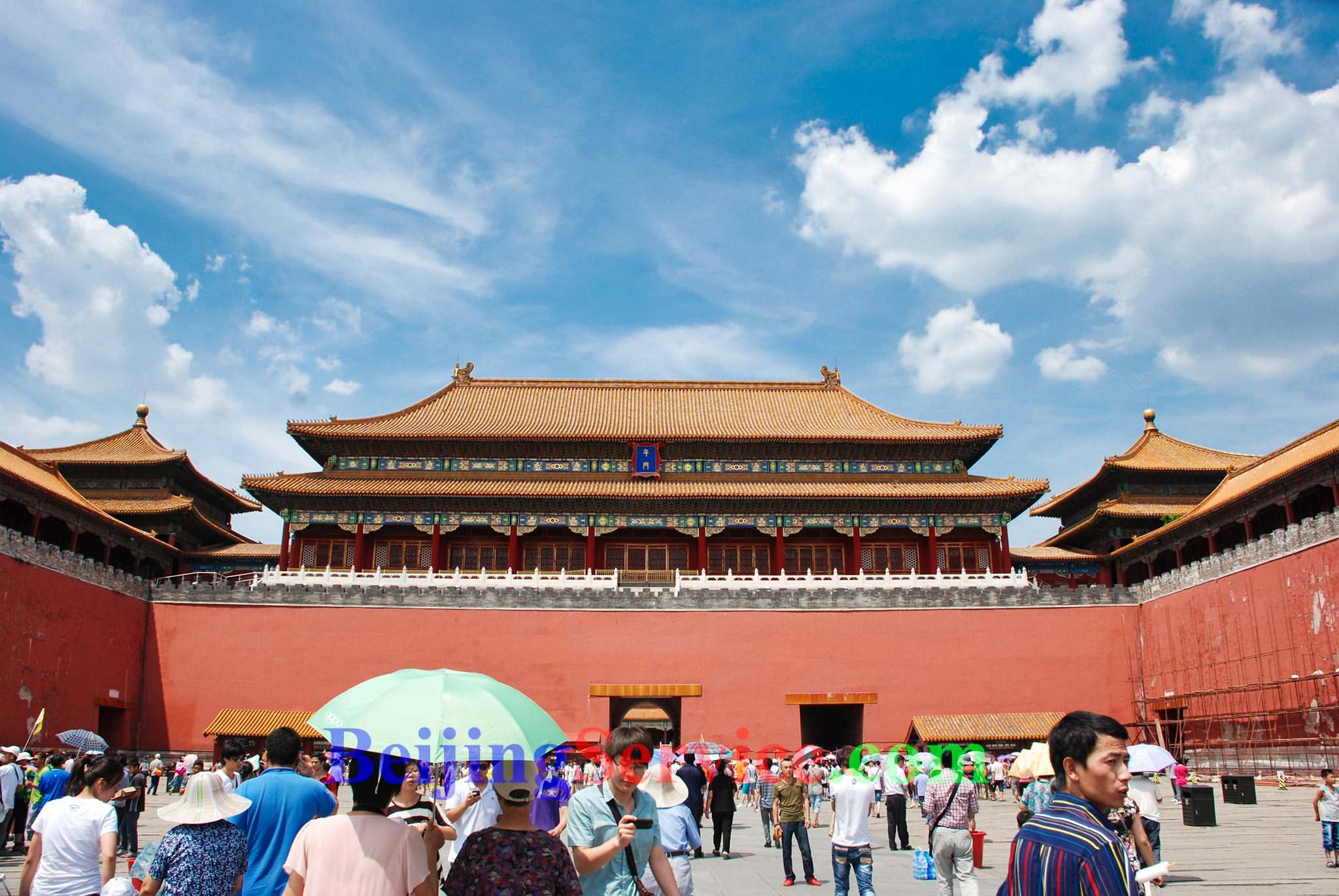
Meridian Gate is the main entrance to the Forbidden City. It is called Meridian Gate because the emperor believed that his residence was the center of universe and that the meridian line went right though the city.
The Meridian Gate was first built in 1420 and rebuilt in 1647. It is 35.6 meters high with five openings. The central one was only for the emperor. High-ranking civil and military officials went through the side gate on the east and royal family members on the west. Further side gates were for the low-ranking officials.
Empress was granted the privilege of using this entrance once, and only once, on her wedding day. As a special honor, the three finalists who achieved the highest awards in the national examinations presided over by the emperor, would be permitted to march through this archway, following their interview with the emperor. The smaller arch to the east was used by ministers while that to the west was used by the royal family. The remaining arches were used by petty officials. Ordinary people were forbidden to enter the city.
The Meridian Gate was the place to announce the new lunar calendar for the following year, to celebrate victories and accept prisoners of war from the dispatched generals. This was also the place where emperors in the Ming Dynasty would punish the offending officials by heating them with sticks. It was recorded that in 1519 as the emperor wanted to select beauties from the lower Changjiang valley, ministers tried to dissuade him. The emperor got infuriated and 146 officials got beaten on one occasion and 11 were beaten to death on the spot. This punishment, known as "court beating", was abolished in the Qing Dynasty.
The gate is surmounted by five towers known as the Five-Phoenix Tower, the main gate-tower is the rectangular in shape and flanked by massive wings to the east and west. On each wing are two square towers connected by covered galleries. Drums (on the east) and bells (on the west) were installed in the towers. When the emperor went to Tiantan( the Temple of Heaven), bells were struck, and when he offered sacrifices to the deceased emperors in Taimiao (the Ancestral Temple), drums were beaten to make it known to the public.
Gate of Divine Prowess (Shenwumen) Gate of Divine prowess (Shenwumen) is the north gate of the Forbidden City. On its tower were bells struck in the morning and drums beaten in the evening in the old days to mark time. The empress and imperial concubines left the palace through this gate to attend the ceremony of starting silkworm-breeding season.
Chongzhen, the last emperor of the Ming Dynasty, went through the Gate of Divine prowess to the Coal Hill to hang himself in 1644.
More Photos


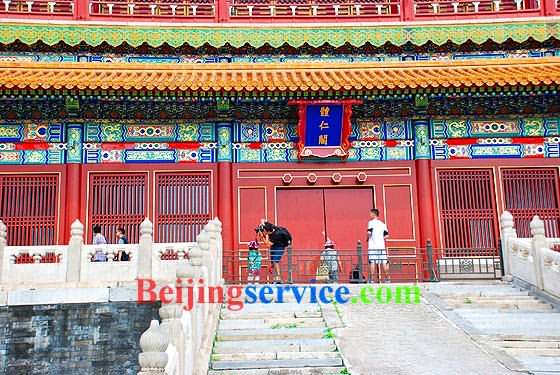

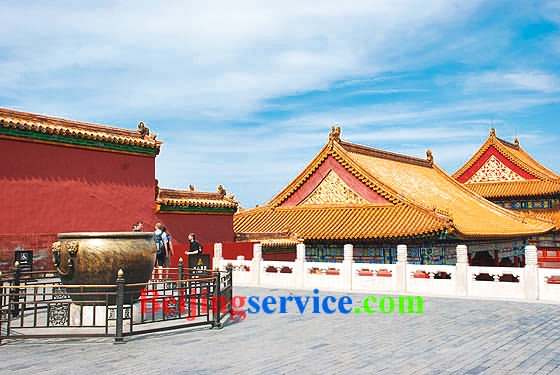

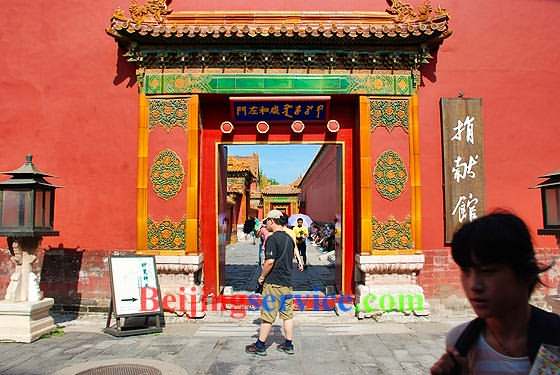
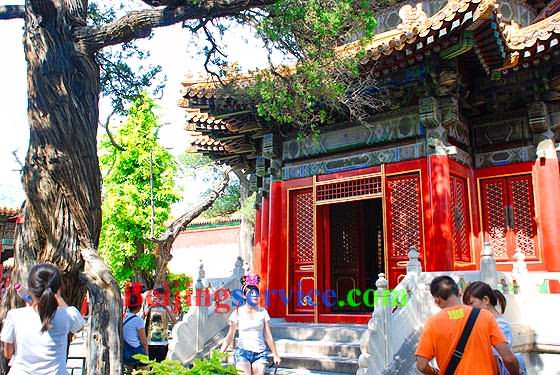
Toolkits
Link to this page
Beijingservice team provides deep information related with Forbidden City. Please link to this pae if you like the information.- Forbidden City
- Forbidden City, also called Palace Museum or Gugong in Chinese, is located in the center of Beijing, to the north of Tian'anmen Square. It was the imperial palace during the Ming and Qing dynasties. Forbidden City is the largest and best-preserved palace complex in China and the treasure house of Chinese cultural and historical relics. The palace consists of 90 palaces and courtyards, 980 buildings and 8,704 rooms. It was listed as the World Cultural Relics in 1987.
- https://www.beijingservice.com/forbiddencity.htm
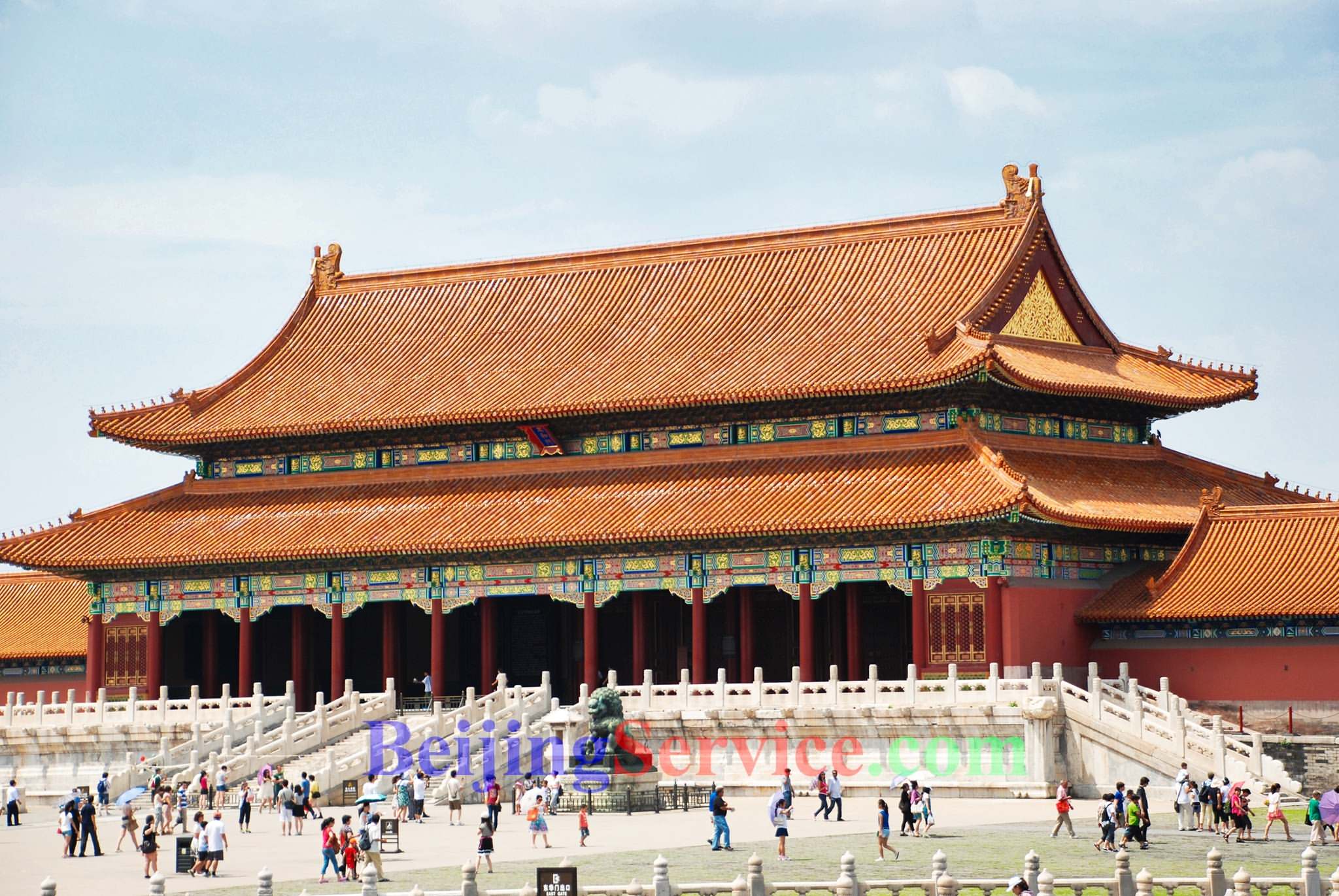
- Main Buildings of Forbidden City Hall of Supreme Harmony (Taihedian) Hall of Supreme Harmony is the most striking building in the entire Forbidden City. Entering Taihemen (Gate of Supreme Harmony), you will see Taihedian (Hall of Supreme Harmony) across the spacious square, which covers of 30,000 square meters. The Hall of Supreme Harmony is the highest building in the Forbidden City and not even trees could overshadow it. Hall of Supreme Harmony is also called the "Throne Hall" or "Golden Carriage Palace". It was first built in 1420, but was burnt down several times, and the present hall was rebuilt in 1695.
Hall of Supreme Harmony used to be the place where emperors received high officials and exercised their rule over the nation. Grand ceremonies would be held here when a new emperor ascended the throne. It was also used for ceremonies which marked emperors' birthdays, wedding ceremonies, Winter Solstice, the Chinese New Year and the dispatch of generals into fields of war.
Alongside the flights of steps which ascend the three tiers of the terrace, there are eighteen bronze Dings, a kind of ancient Chinese vessel, representing the eighteen national provinces of those times. On the luxuriously balustrade terrace, stands a bronze crane and a bronze tortoise, symbols of everlasting rule and longevity. The marble Rigui, an ancient sun dial on the eastern side and the Jialiang, an ancient measuring vessel on the western side demonstrate that the emperor was both just and fair. In front of the hall, there are a couple of gilded bronze vats, which were used to hold water in case of fire.
The 35.05-metre-high (115-foot-high) hall was the tallest building in Beijing during the Ming and Qing Dynasties. The traditional way calculating the interior space of a building was to count the number of squares. Space enclosed by four pillars was treated as one room, so this hall can be said to have 55 "rooms", 11 rooms wide and five rooms deep.
Inside of the hall, the floor is paved with special bricks which were fired long and then polished by being soaked in tung oil. The emperor's throne was carved out of sandalwood and gilded. The throne is located in the center of the hall and surrounded by six thick gold-lacquered pillars decorated with dragons. Dragons are carved all over the golden throne. Around the throne stand two bronze cranes, an elephant-shaped incense burner and tripods in the shape of mythical beasts. The magnificent sculpture on the ceiling shows a dragon playing with a huge pearl, which is said to be the earliest mirror made in ancient China. It symbolized that the emperor was the legitimate successor.
During the ceremonies in the Ming and Qing dynasties, the civil and military officials would position themselves according to their ranks; kneel down as guards of honor stood by. The emperor seated on his throne was wreathed in fragrant clouds of incense rising from the incense burners inside and outside the hall. The imposing surroundings and awesome atmosphere were designed to leave an impression on all the attendants that he was the "son of Heaven".
This is also the place where the last Qing Emperor Puyi ascended the throne in 1908 at the age of three. He was so scared at the complicated procedures that he kept crying and shouting: "I don't want to stay here, I want to go home." His father tried to soothe him and said, "It will soon be over." The civil and military officials got stunned when they heard of this saying, for they thought it suggested that the dynasty would soon be over. Three years later, the Qing Dynasty that had lasted 267 years did collapse.
Hall of Preserving Harmony (Baohedian) Architecturally, the Hall of Preserving Harmony has no supporting pillars in its front part, something typical of Ming architecture.
In the Qing Dynasty, banquets were given on New Year's Eve in honor of Mongolian princes and high-ranking officials. The Hall Preserving Harmony was used as a banquet hall to entertain the princes and envoys of the Mongolian and other nationalities on Lunar New Year's Even. During the Qing Dynasty, it was the place for the imperial examinations held once every three years. Three hundred scholars from all over the country came to this hall and took the exams that lasted three days and three nights.
The civil service exams in china started in the Han Dynasty (206BC-220AD), and served the purpose of recruiting Confucian scholars to be ministers and high officials, but later it was suspended. The system resumed in the Tang Dynasty and lasted until 1905.
In the Ming and Qing dynasties, there were three levels of exams: the county and prefectural level, the provincial level and the national level. The national level exam was presided over by the emperor himself. The three scholars who passed the exam with the best score would get honorable titles. They would have the honor to ride on horses through the streets and go through the central gate of the palace. This was deemed the greatest honor for scholars in the past.
The stone carving is part of the marble staircase at the back of the Hall of Preserving Harmony. It is carved with designs of clouds and nine dragons. This was the biggest stone carving in the palace in the Ming Dynasty, and it was re carved during the reign of Qing emperor Qianlong. The stone slab is 16.75 meters long, 3.07 meters wide, 1.7 meters thick and weighs about 250 tons. It was quarried from Fangshan District, 70 kilometers southwest of Beijing, and the transportation required twenty thousand people. Can you imagine how they managed to carry such a huge stone all the way to the palace without modern means of transport? In winter they sank wells along the way, and poured water on the ground to make a road of ice. And in summer, they used rolling logs instead. The work at that time brought tremendous hardship to the laboring people.
Palace of Heavenly Purity(Qianqinggong) The Palace of Heavenly Purity is the first building in front of you when you enter the inner court of Forbidden City.
In front of the Palace of Heavenly Purity, there is a small miniature pavilion on each side. One is called Jiangshan pavilion. Representing territorial integrity; the other is Sheji Temple, the God of Land and Grain, Symbolizing a bumper harvest.
In the main hall, there hangs a plaque with the inscription written by the first Qing emperor Shunzhi (reigned 16414-1661), which reads: "Be open and aboveboard". Starting from Qing emperor Yongzheng, the name of the successor to the throne was no longer announced publicly for the reason of security. Instead, the emperor wrote the name on a piece of paper, had it placed in a small box and had the box stored behind this plaque. The box would not be opened until the emperor passed away.
The Palace of Heavenly Purity was the palace where the emperors used to live and handle daily affairs in the Ming and early Qing dynasties.
Palace of Union and Peace (Jiaotaidian) The Palace of Union and Peace, also called Jiaotaidian in Chinese, was the place that the empresses held important ceremonies or celebrations, such as the conferment of honorable titles and birthday celebrations.
Twenty-five seals representing imperial power were kept in the palace of Union and Peace in 1748 during the reign of Qing emperor Qianlong(1736-1795). The number of 25, the total of the odd numbers: one, three, five, seven and nine, was regarded as a heavenly number. To have 25 seals means that the emperor received the authority from Heaven. The water clock on the east side in this hall is a time-measuring apparatus made in 1745. The method of keeping time by the dripping of water was invented by the Chinese people more than 2500 years ago. The time-piece consists of five bronze vessels. Each vessel has a small hole at the bottom to drip evenly through the holes. There is a figurine in the lowest container. The calibrated scale in his hands floats with the rising water, and time is indicated on the markings.
To the west is a western chiming clock made in 1789 by the works of Department of the Board of Imperial Household.
The two Chinese characters inscribed on the plaque, which hangs in this palace, are "Wu Wei", meaning to govern the country by noninterference, as was done by shun, a legendary sage king in ancient China. Wu Wei is Taoist philosophy, meaning to adapt oneself to the change of nature. Taoist philosophy stressed the oneness and Continuity of the material and spiritual worlds. To Taoists, humanity stands midway between heaven and earth. The feudal ruler used this idea to discourage people from taking action.
- Other Buildings and Garden in Forbidden City Imperial Gardens(Yuhuayuan) The imperial Garden is 90 meters (98.5 yards) long from north to south and 130 meters (142 yards) wide from east to west.
The main building in the garden, Qin'andian (Hall of Imperial Peace), is situated on the central axis of the Forbidden City, with a number of pavilions, terraces and towers arranged symmetrically to the east and west. With most of the buildings set against the palace wall, the garden looks quite spacious. The hall of Imperial peace is a Taoist temple and the religious building along the central axis. Inside the hall stands the statue of the king of Xuan Wu, who was believed to be the God of water and could prevent the palace building from catching fire. In front of the hall are two 400-yearl-od cypress trees with their branches entwined. The 4-meter-high (13-foot-high incense) burner in the garden is the biggest bronze incense burner in the Forbidden City. The six smoke outlets are in the shape of two dragons playing with a ball.
Four pavilions representing the four seasons flank the left and right of the Hall of Imperial Peace.
Fubiting (Jade-green Floating Pavilion) and Chengruiting (the Pavilion of Auspicious Clarity).
Slightly to the north are the Fubiting (Jade-green Floating Pavilion) and Chengruiting (the Pavilion of Auspicious Clarity). Both are square pavilions over a pond, with open roofed corridors on their southern sides.
Wanchunting (the pavilion of Ten Thousand Springs) and Qianqiuting (the Pavilion of One Thousand Autumns)
Stepped and uniform in plan, the two other pavilion stand to the south: Wanchunting (the pavilion of Ten Thousand Springs) and Qianqiuting (the Pavilion of One Thousand Autumns). The pathway in the garden is paved with tiny cobbles of various colors in 900 mosaic designs, covering a wide range of subjects.
Near the north gate, there is a group of man-made rockeries, called Duixiu (Collecting Elegance) Hill with Yujingting (Imperial View Pavilion) on the top.
In the Qing Dynasty, every emperor would climb up to the pavilion on the Double Ninth festival (the ninth day of the ninth lunar month) to enjoy the scenery with his empress and concubines. According to the old saying in China, climbing up hills that day can escape misfortune. Therefore, even today, Chinese people, especially the aged, still celebrate the Double Ninth Festival in this way every year.
At the north gate of the Imperial Garden are placed a pair of gilded bronze elephants, symbolizing universal peace.
Six Eastern and Western Palaces and Outer Eastern Palaces The six eastern palaces and six western palaces, located on the east and west sides of the three rear palaces respectively, was the residences of imperial concubines. With a surrounding wall each palace forms a compound of 2,500 square meters (3,000 square yards). The main halls stand in the middle and the side-chambers are in the east and west. The hall in the front yard was used for formal ceremonies, and the hall in the backyard served as the bedchamber. The architecture of the 12 palaces, connected by passageways, is more or less the same.
Empress Dowager Cixi once lived as a concubine in Chuxiugong (Palace of Gathering Elegance), one of the six western palaces, and her son, Emperor Tongzhi was born right here.
The six eastern palaces and six western palaces were restored several times during the Qing Dynasty. To celebrate Empress Dowager Cixi's 50th birthday in 1884, it was completely refurbished at a fabulous cost of silver. She moved in on her birthday and resided here for ten years.
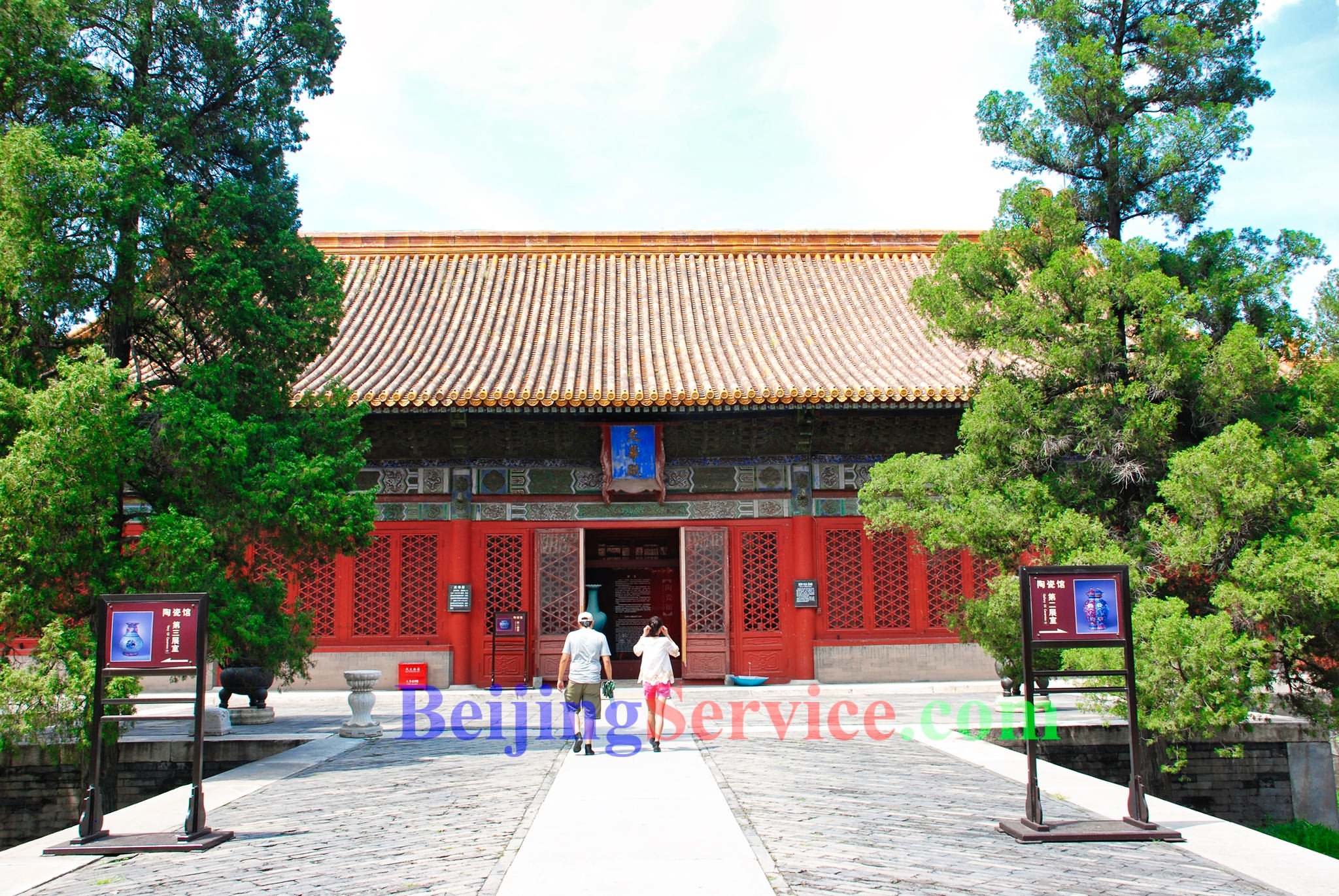
The palace today retains the shape of that renovation. The "Eulogy of Longevity" was presented to Cixi by two scholars on her 50th birthday and inscribed on the wall, which can be seen clearly even today. The six eastern palaces are now used as exhibition halls for traditional Chinese arts such as bronze and porcelain.
In a separate enclosure further east were palaces called "the outer Eastern Palaces", which were specially built for the retired Emperor Qianlong and later inhabited by Cixi, the, Empress Dowager, before and after her 60th birthday.
Qianlong was the fourth Qing Emperor and reigned from 1736 to 1795. When he was 85 years old, he decided to abdicate and offer power to his son. Emperor Qianlong died in 1798 at the age of 89. This group of building is independent of the other parts of the imperial palace; however, the general plan is made exactly after that on the central axis. The main buildings in this area are HuangjidianHall of Imperial supremacy, Ningshougong (Palace of Tranquil Longevity) in the front part; Yangxindian Hall for Cultivating Charter, Leshoutang (Hall of Joyful Longevity) and yihexuan pavilion of Sustained Harmony in the back part. At present, these halls are used as an exhibition of treasures.
At the entrance to the outer Eastern palaces, there is a Nine-dragon Screen, erected in 1773 during the reign of Emperor Qianlong as a decoration.